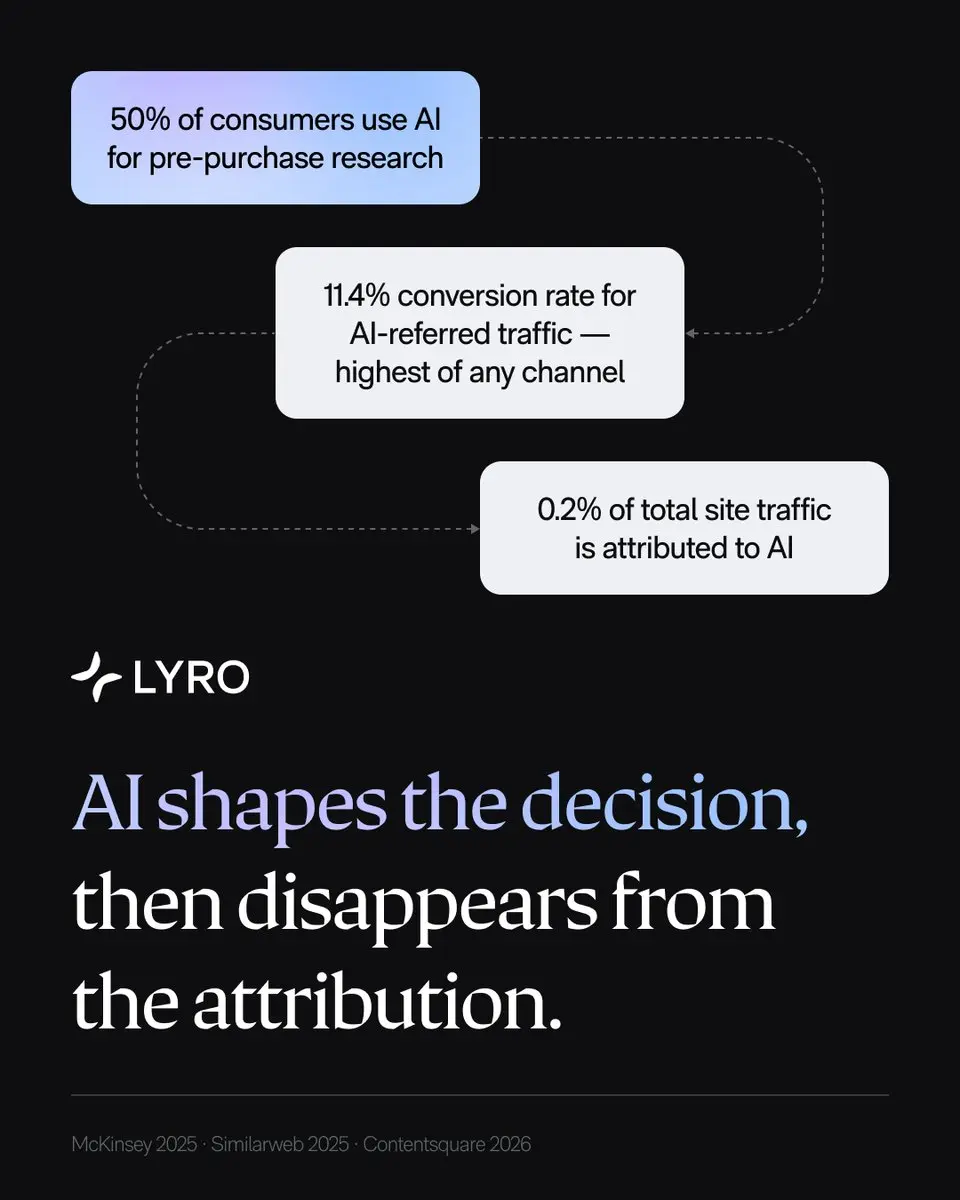
A new research report from Tidio, an AI-powered customer service platform, has uncovered a significant discrepancy between consumers' reliance on artificial intelligence for product research and the minimal credit AI receives for driving web traffic. According to McKinsey, half of consumers now use AI as their primary or preferred source for product research. However, Contentsquare's analysis of retail web traffic shows that AI-referred sessions account for only 0.2% of total visits. Tidio's report, published today, explores this gap and its implications for businesses.
The report, which analyzes data from multiple sources, including McKinsey, Contentsquare, Similarweb, and Morgan Stanley, finds that AI is shaping purchase decisions at a scale that current attribution models cannot capture. This phenomenon, termed 'dark AI,' refers to the invisible influence of AI on consumer behavior that is not reflected in traditional traffic metrics. For instance, a consumer might use ChatGPT to research a product but later visit the retailer's website directly, bypassing any AI referral tag.
Similarweb data cited in the report shows that ChatGPT-referred U.S. retail sessions have a conversion rate of 11.4%, the highest of any measured channel. This suggests that tagged AI referrals represent high-intent traffic from a much larger pool of AI-influenced journeys. The report emphasizes that brands failing to prepare for this shift risk losing 20–50% of traditional search traffic by 2028, as projected by McKinsey. Additionally, Morgan Stanley estimates that AI agents will influence $190–$385 billion in U.S. e-commerce spending by 2030.
Bart Turczynski, Tidio's Head of Communications, noted that the 'dark AI' gap presents both a challenge and an opportunity for businesses. Companies that optimize their content and customer experience for AI-driven discovery can capture this hidden influence, while those that ignore it may fall behind. The report recommends that brands adopt AI-friendly strategies, such as structuring data for AI crawlers and integrating AI agents into customer service, to bridge the attribution gap.
For more details, the full report is available at Tidio's website. Tidio's AI agent, Lyro, is designed to help businesses automate customer service and drive sales, further illustrating the growing role of AI in e-commerce.