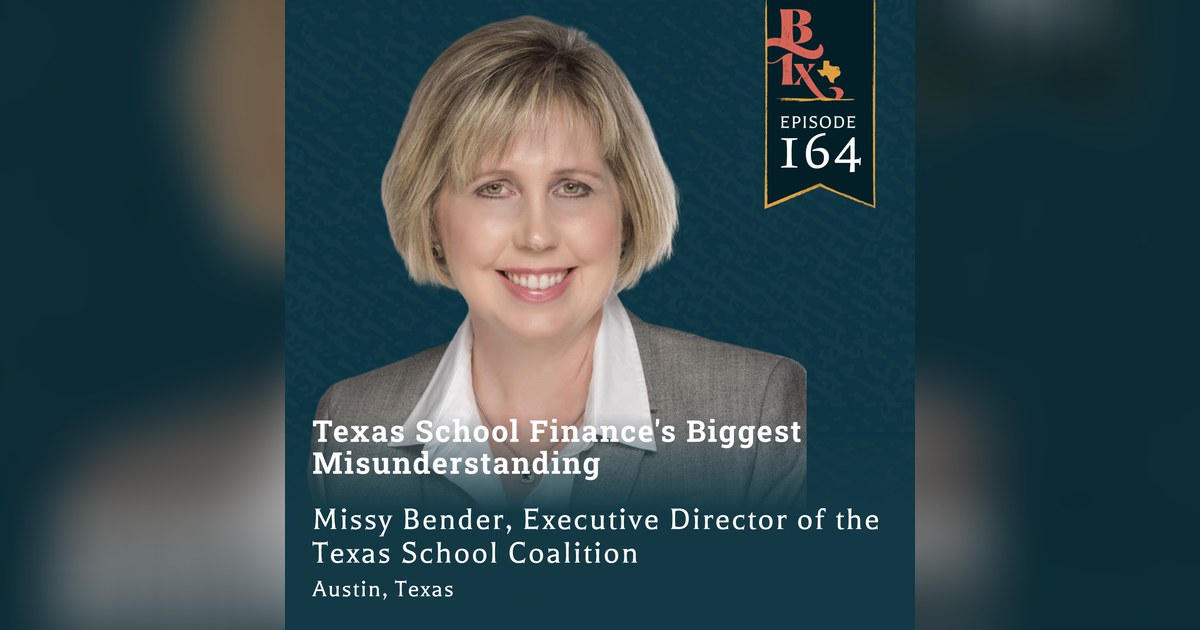
In a recent episode of The Building Texas Show, host Justin McKenzie sits down with Missy Bender, Executive Director of the Texas School Coalition, to dismantle one of the state's most persistent policy myths: that recapture, often called "Robin Hood," redistributes tax dollars from property-wealthy school districts to property-poor ones. Recorded in Plano and published July 13, 2026, the conversation reveals where the nearly $3 billion Texas schools sent back to the state in 2025 actually ends up.
Bender explains that recapture, established under House Bill 3, requires districts with property wealth above a certain threshold to send excess funds to the state. These funds flow into the Foundation School Program (FSP) and reduce the state's share of education spending, freeing up money for other uses. "So what does recapture do? It generates state savings," Bender says. "That's why I don't call it Robin Hood anymore. It's not the property wealthy helping the property poor, like many think, but it's only helping the state." She adds that some school boards have considered withholding payments as a form of protest but warns that board members "can actually go to jail for doing that."
The episode breaks down the mechanics of recapture, focusing on how property valuation divided by average daily attendance triggers the threshold. Districts like Plano ISD face a "double whammy" of declining enrollment and rising property values, forcing them to send millions back to the state. In 2025, top payers included Austin ISD at $770 million and West Texas oil district Pecos-Barstow-Toyah at $198 million. With about 20% of all Texas districts now paying recapture—including a growing number of urban and rural districts—the issue has become a pressing concern as legislators head into election season.
Bender also highlights the impact of attendance-based funding, noting that a student leaving for a doctor's appointment can cost a district a full day of state funding, even when the absence is excused. She argues that 96% attendance, once religious and medical absences are counted, should be treated as the practical ceiling. She is working on legislation to stop penalizing districts for excused partial-day absences.
The broader policy conversation traces the money's path through the FSP, where recapture funds reduce state contributions that Bender says can be redirected to "water, transportation, it could be vouchers, it could be anything." She references the funding adequacy study led by Dr. Lori Taylor at Texas A&M and notes that the Legislature went six years without increasing the basic allotment despite inflation. The episode reframes a debate most Texans only encounter as a tax-bill line item, urging a more informed discussion as the state grapples with how to fund its growing student population equitably.
The Building Texas Show, hosted by Justin McKenzie, spotlights operators, advocates, and civic leaders shaping the state's future. New episodes release weekly across YouTube, Facebook, Instagram, and LinkedIn. This episode is available now wherever podcasts are heard.