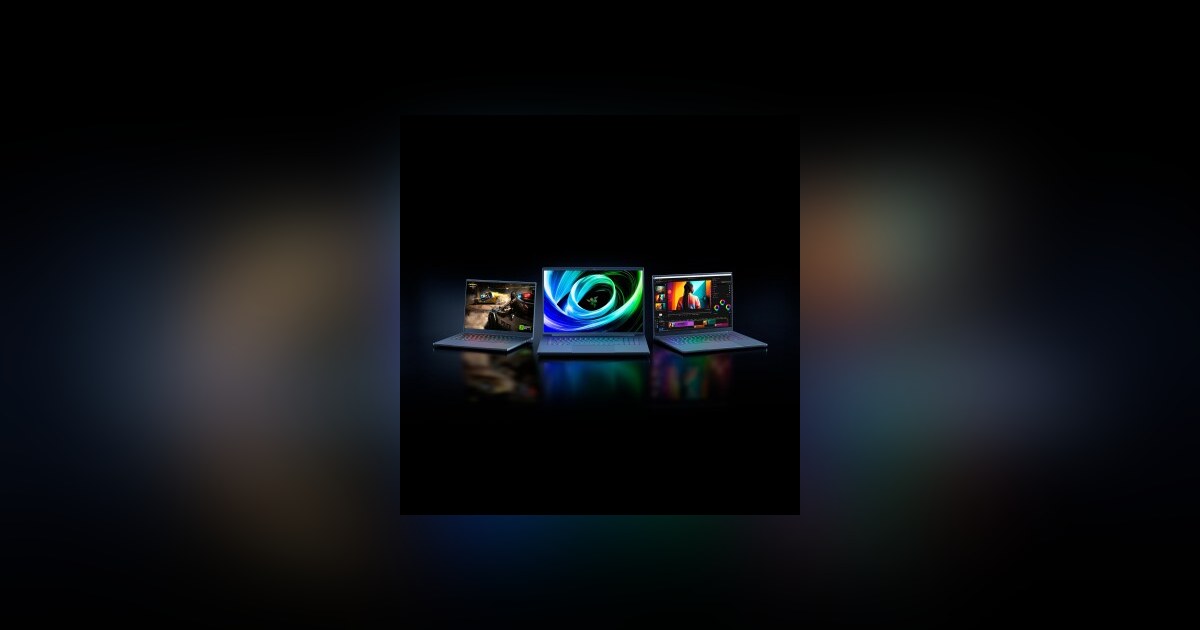
Razer has unveiled its 2026 Blade laptop lineup, comprising the Blade 14, Blade 16, and Blade 18, each engineered to cater to specific user needs ranging from extreme portability to desktop-replacement performance. The announcement underscores Razer's strategy to cover diverse segments of the gaming and creator markets, with configurations featuring the latest NVIDIA GeForce RTX 50 Series GPUs, Intel or AMD processors, and advanced cooling systems.
The Blade 14 targets gamers and professionals who prioritize mobility. Weighing 1.63 kg and measuring 15.8 mm thin, it packs up to an RTX 5070 GPU and AMD Ryzen AI 9 processor with a 50 TOPS NPU. Its 72 Wh battery and 14-inch QHD+ OLED 120 Hz display make it suitable for all-day productivity and gaming on the go. This model starts at $2,299, appealing to users who need a lightweight yet capable machine.
The Blade 16 positions itself as a travel-ready all-rounder, offering flagship performance in a slim chassis. It features up to an RTX 5090 GPU at 165W TGP, AMD Ryzen AI 9 HX 370 processor, and up to 64 GB of LPDDR5X-9600 MHz memory—the fastest laptop RAM currently shipping. The 16-inch QHD+ OLED 240 Hz display with VESA TrueBlack 1000 HDR delivers both high refresh rates and color accuracy. Priced from $2,399 to $5,599, it is designed for streamers, creators, and gamers who demand high performance without sacrificing portability.
For power users, the Blade 18 offers desktop-class performance with a 24-core Intel Core Ultra 9 290HX Plus processor and RTX 5090 at 175W TGP. It is the only model with slotted DDR5 RAM (up to 128 GB) and dual M.2 NVMe slots (up to 8 TB), allowing for future upgrades. The 18-inch display can switch between UHD+ 240 Hz and FHD+ 440 Hz modes, catering to both content creation and competitive gaming. Starting at $3,499 and reaching $6,999, it targets hardcore gamers, AI developers, and professional creators who need sustained performance under heavy workloads.
The implications of this lineup are significant for the laptop market. By offering differentiated specs and price points, Razer ensures that users can select a machine tailored to their specific workflow—whether that involves frequent travel, balanced productivity, or intensive AI training. The use of vapor chamber cooling across all models indicates a focus on thermal management, crucial for maintaining performance during extended sessions. Additionally, the inclusion of Thunderbolt 5 on the Blade 16 and expandable storage on the Blade 18 highlights Razer's attention to future-proofing.
As AI workloads become more common in gaming and content creation, the Blade 14's NPU and the Blade 18's high-core-count CPU position these laptops as tools for local AI processing. The 2026 lineup reinforces Razer's commitment to the gaming and creator ecosystems, providing options that eliminate the need for separate desktop and laptop setups for many users. For more details, visit the Razer Blade 14, Razer Blade 16, and Razer Blade 18 product pages.