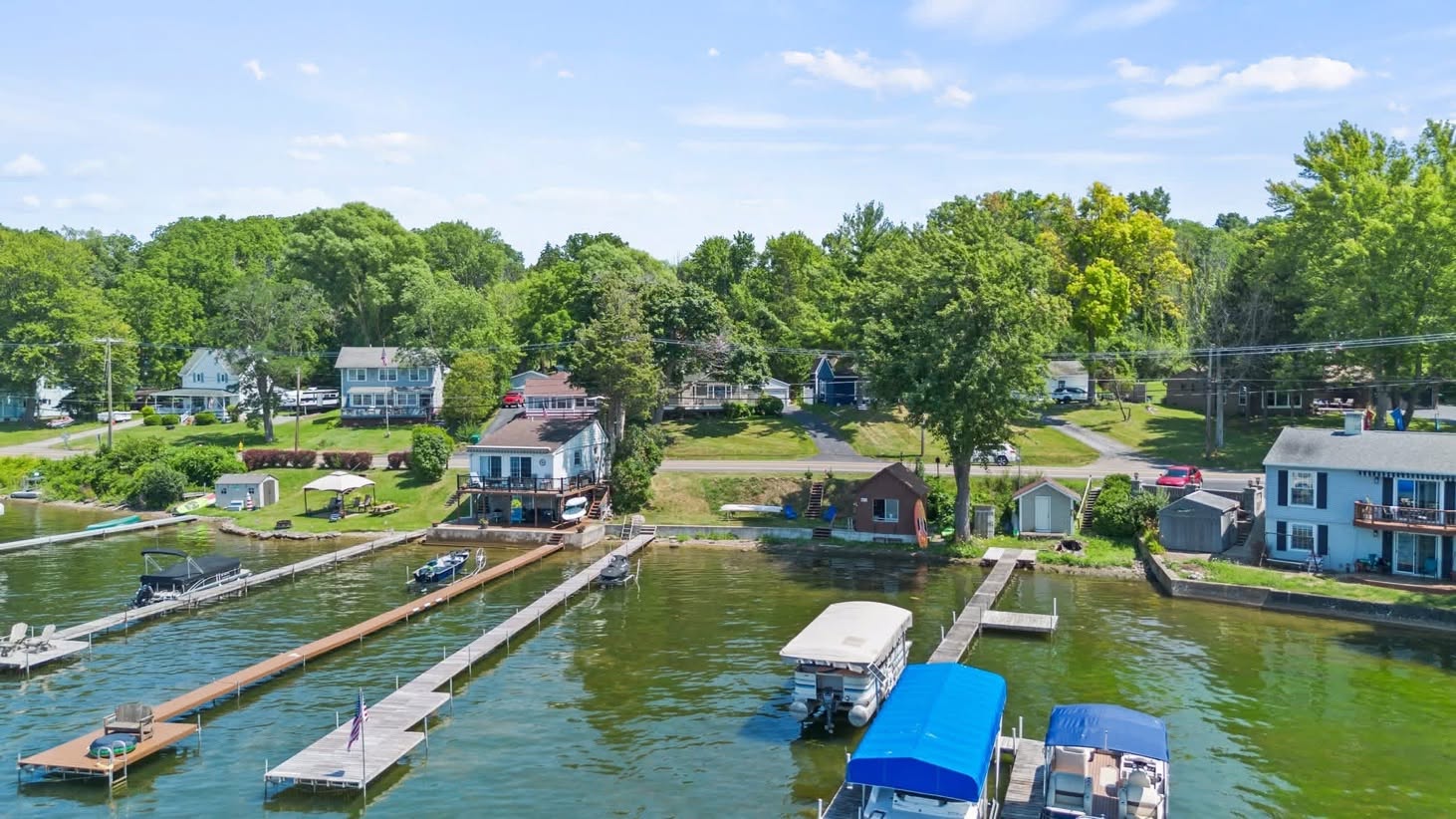
In the market for waterfront property on Conesus Lake, the number that often appears first in listings—linear feet of frontage—is a less reliable indicator of value than buyers and sellers assume. While frontage is commonly divided into the asking price to create a per-foot metric for comparison, real estate professionals working the lake say this single number obscures more than it reveals.
Matthew Sharman, team leader of The Sharman Team at Real Broker NY LLC, points to a recent listing with over 60 feet of frontage, which would seem ample by local standards. However, the footage ran along a curve, allowing neighboring dock placements to encroach on usable water. A straight 60-foot stretch with neighbors squarely to either side would have supported a materially higher price. “All frontage is not the same,” Sharman says.
Across 39 Conesus Lake waterfront closings in the past twelve months, the median sale price was $13,000 per foot of frontage, but individual sales ranged from under $700 to more than $44,000 per foot. This wide variance underscores that frontage length alone does not determine value. Sharman’s valuation process, which he calls a Property Value Review (PVR™), weighs condition, competing inventory, buyer behavior, and property-specific features alongside comparables, treating frontage quality and usability as separate inputs from raw length.
The distinction is most critical in negotiations, where both parties often anchor to the raw figure. A buyer working only from footage cannot price the difference between clear frontage and compromised frontage, and neither can an agent who visits the lake occasionally. Sharman advises that the useful analysis is not what the number says but how the water in front of the parcel actually functions. Water depth compounds the issue: shallow water constrains dock placement, raises hoist installation costs, and may limit what can be moored—none of which appears in a listing and varies point to point around the lake.
Another variable that resists a simple metric is the legal shape of lake access. Properties across the road may hold deeded access ranging from sole use of a narrow strip to shared rights among several households. The number of households sharing is often the largest determinant of what that access is worth. Access split two ways versus six ways are not comparable assets, though both may be described identically on paper. Some arrangements have been formalized into LLCs with maintenance funds and written procedures, while many remain “handshake agreements,” as Sharman notes. Neither structure is inherently defective, but they carry different risk profiles and friction costs; pricing one as though it were the other misprices the purchase.
This complexity also makes the lakefront premium less reliable than it appears. Across-the-road properties often sit on larger lots, at elevation, with better sight lines and more room to expand. A substantial home with generous parking and access shared with one neighbor can compete on value with a small waterfront cottage on a tight lot. The premium attaches to specific conditions, not to the category.
Beyond access, several physical characteristics move value significantly. Build history is one: much of the housing stock dates from the 1920s through the 1950s and has been extended repeatedly, sometimes without permits. Homes rebuilt from the mid-1980s onward tend to command a premium because they were designed as complete structures rather than accumulated in stages. Parking is systematically underestimated—one or two spaces may suffice until guests arrive, and road parking is limited or prohibited around most lakes. Garage space is similarly important because lake ownership generates equipment that needs storage.
Kitchen orientation is a preference buyers express consistently but listings rarely capture. Older cottages often have galley kitchens facing the road, isolating the cook from the water view. Sharman notes, “You’d be amazed at the amount of buyers that have been not happy with the idea that they’re closed off in this kitchen while everyone else is enjoying the meal.” He attributes part of this shift to vacation rental standards, where a water-facing kitchen has become an expectation. Bedroom usability follows the same logic: cottage second stories often have rooms too small or steeply pitched to function, so properties with dormers or raised rooflines that create genuinely usable space stand out. Road position also matters—main arteries carry traffic at speed, so small off-road pockets trade at a premium for noise reduction and safety.
These variables mattered less in 2020 and 2021, when scarcity compressed analysis and buyers absorbed compromises to transact. The current market has restored the distinctions: properties are surviving longer negotiations and taking price reductions, and buyers are declining to concede on features they previously overlooked. The practical consequence is that properties performing well across multiple dimensions—clear frontage, workable access, intentional build, parking, orientation—are holding price, while those strong on one metric but weak on others absorb the correction. A price-per-foot calculation cannot distinguish between the two.
In a market with fixed inventory and thin comparables, valuation is moving away from single-metric shorthand and toward assessment of how a specific parcel functions. It is a slower analysis that depends on knowledge of a particular shoreline rather than a regional average.